
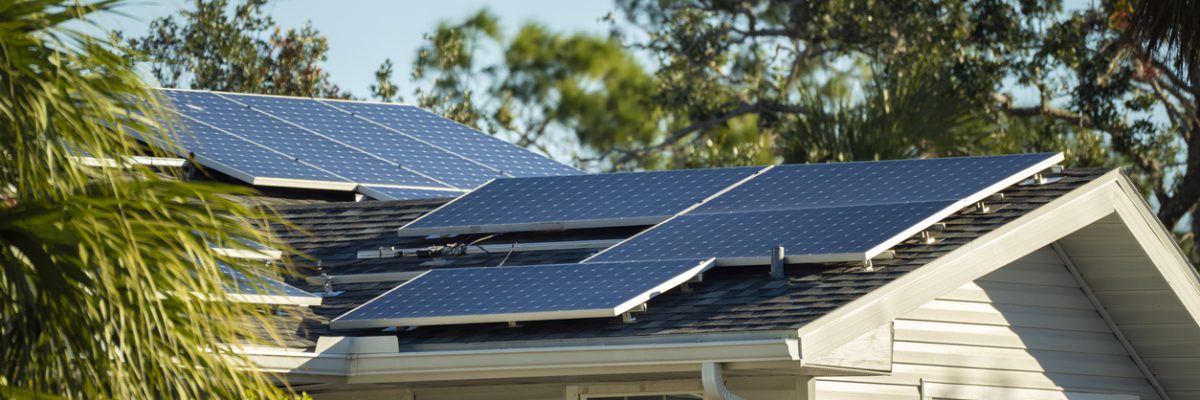
Ontario launched the Home Renovation Savings Program in 2025 to help homeowners invest in energy upgrades. One year later, we have a clearer picture of how the program is working, and a practical perspective on uptake since launching TAF’s Home Solar Accelerator this spring. The province’s program includes rebates of up to $5,000 for rooftop solar, and an additional $5,000 if you include battery storage. At first glance, it sounds like a great deal for families looking to lower their electricity bills and invest in clean energy.
But there is an unexpected condition attached to the solar rebate: if you accept it, you are barred from participating in net metering – for the life of the solar system. Our analysis, and our conversations with solar installers, shows this creates a major problem: Most homeowners will be financially better off refusing the rebate and net metering instead. In fact, many solar installers are advising their customers not to participate in the HRSP program for that very reason. It’s time the province gave the restriction on net metering a second look.
What is net metering?
Net metering is a billing arrangement that allows homeowners with solar panels to receive bill credits for excess electricity sent back to the grid. At the end of the month, the homeowner only pays for any net electricity consumed after subtracting the bill credits. If generation exceeds consumption, surplus credits can be carried forward for up to 12 months.
Net metering is key to the viability of residential solar, because solar production and household electricity use rarely match perfectly in real time. For example, on a sunny weekday when the panels are producing at their peak, the home may be empty as people are away at school or work. Without net metering, all that energy is either wasted or exported to the grid with no compensation, leaving homeowners unable to recoup the value of their solar investment. Which is why net metering has been a core part of Ontario’s solar policy for years.
Why does the rebate program prohibit net metering?
Ontario’s rebate program is part of the IESO’s broader electricity Demand Side Management (eDSM) program. These programs are governed by a policy framework set out in a letter of direction from the Ontario Minister of Energy and Mines.
The framework states that demand side management programs should exclude “those measures promoted through a different program or initiative undertaken by the Government of Ontario”. This language was intended to prevent the same projects from qualifying for two different rebates (e.g. a rebate from the IESO and a rebate directly from the province).
Why the rebate economics aren’t working
For most households, the long-term value of exported electricity bill credits significantly exceeds the program’s upfront incentive. A 10 kW system with net metering has roughly half the payback period of a comparable system without it, even when the rebate is included. The rebate can be advantageous for some households, particularly those with very limited available roof space who want to pair solar with a battery. But the majority of Ontarians would be financially worse-off for accepting the rebate.
Solar businesses are seeing this play out directly. They welcome support that reduces upfront costs, but report growing confusion among homeowners about why accepting a rebate means giving up access to net metering. Here’s what we heard from those working on the ground:
“Once we explain this trade-off, the return on investment no longer makes sense for most customers. As a result, we effectively end up advising homeowners not to use the program, as net metering without a rebate consistently delivers better long-term value.” — Jordan Kruhlak, Founder, Glean
“This program is causing a lot of confusion for customers. It’s hard to explain to people that if they take the incentive, they won’t be allowed to net meter. Since the business case is better with net metering, even without the rebate, customers are confused as to why the province is offering this.” — Beau Badore, Owner, Heliotechnik
“From a financial perspective, net metering delivers far better value than the incentive. At this point, we’re actively steering customers away from the program because it doesn’t support a sustainable or sensible investment in solar.” – Gopal Shrestha, Principal, Herc du Soleil
The design of the HRSP solar rebate also encourages homeowners to undersize their solar system, compared to both the amount of electricity the home consumes and the available roof space. The rebate maxes out at $5K for a (relatively small) 5kW system, and without net metering there is no financial benefit to sizing larger (as any energy that can’t be instantly consumed in the house is given away to the grid for free). Small solar systems have a higher cost per kW, because they are less attractive to contractors and pay the same fixed interconnection and permit costs as a larger system would. At a time when Ontario is planning for significant growth in electricity demand, shouldn’t we be encouraging homeowners to install solar systems that meet as much of their annual electricity consumption as possible?
Distributed energy resources such as rooftop solar and battery storage can reduce peak demand, defer infrastructure upgrades, and improve resilience. But those benefits depend on adoption at scale, and adoption depends on program design that improves rather than worsens the business case.
A practical solution
The straightforward solution would be to allow homeowners who receive solar rebates to participate in net metering like any other solar customer. This would improve the economics of residential solar, encourage larger and more cost-effective solar installations, and support Ontario’s broader electricity and affordability objectives.
This change doesn’t require any new government spending, or any changes to regulations or legislation. It simply requires a clear ministerial directive (a signed letter from the minister) clarifying that net metering is not a government program or initiative for the purposes of the eDSM framework, and therefore that candidates for Ontario rebates need not be banned from net metering. This simple clarification would enable IESO to fix the program and enable at scale adoption of rooftop solar.
Ontario’s Home Renovation Savings Program is a well-intended and promising foundation. However, it doesn’t make sense for the province to offer a rebate program with fine print requirements that leave most participants financially worse-off. Ontario is effectively trying to encourage rooftop solar with one foot on the gas while keeping the other on the brake. Scaled adoption of rooftop solar improves energy affordability for participating households while reducing the need for investments in electricity generation, transmission and distribution infrastructure. Time to take our foot off the brake.
Get more detail in TAF’s policy recommendations submitted to the Ministry of Energy here.

Leave a Reply