
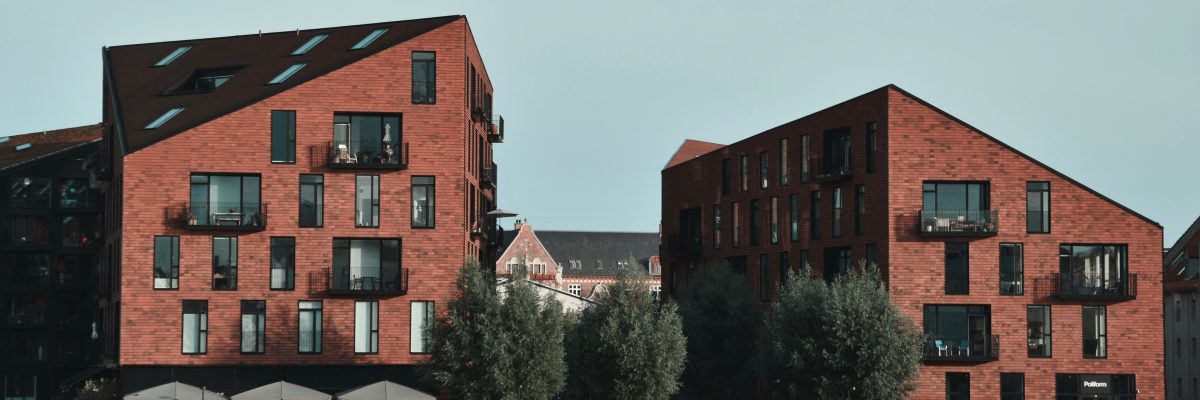
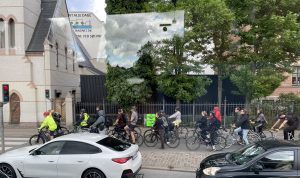
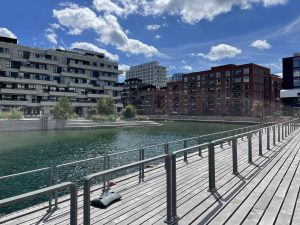
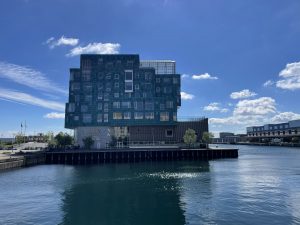
In June, I cycled down protected bike lanes as I traveled across the city, passing by high-performance buildings, urban parks, and bus shelters topped with green roofs. I was biking with families and children and people of all ages, all moving in harmony with vehicle traffic. My destination was the harbour, with a view of a building clad completely in solar panels and where people were enjoying the sun and water in the middle of the day.
That was part of my experience on the Sustainable Buildings Delegation hosted by the Danish Government in Copenhagen. I spent a week with sustainability experts from across Canada and the United States to learn about Denmark’s local climate policies and emerging low carbon technologies. The trip was inspiring and infused me with hope.
During my week with the delegation, I took notes on what the GTHA can learn from Copenhagen.
A city for all
If you’re not familiar with the story, 30 years ago Copenhagen was close to bankruptcy. People were fleeing the city as the housing stock was deteriorating, unemployment was high, and morale was low. Fast forward to today, and Copenhagen has been ranked as the world’s most livable city two years running.
The vision established for Copenhagen was a “city for all” that encouraged cycling, walking, and people-oriented urban planning. Climate and environmental goals were integrated with livability, and climate was not treated as a cost but rather an opportunity. This makes sense—if you put people first, you can’t ignore climate.
Copenhagen’s transformation happened the way that most difficult and rewarding goals are achieved—through consistency over time, acting in alignment with an overarching vision. City leaders had to be able to think and act long-term, staying committed to the plan. Progress on long-term goals can easily be undone by political winds that shift election cycle to election cycle, but Copenhagen seems to have largely avoided this. The mechanics of Copenhagen’s transformation are important, but what gives me hope is that dramatic transformation of the urban environment is possible within a few short decades.
Policy to support a low carbon future
Planning and investing in climate is key to successfully unlocking livability, resilience, and a bustling economy. City leaders recognized that climate action was an opportunity, and they were supported by strong policies from the federal government:
- Mandatory energy labeling has been in effect for more than 20 years. All new and significantly renovated buildings have a publicly available energy score from A to G. While Toronto has made progress with its Energy, Water and Reporting for Buildings program, passing a Building Emissions Performance Standard policy would have a similarly strong impact on improving energy performance in our buildings.
- An ambitious building code results in buildings that are comfortable, resilient, and quiet. The Danish building code is performance-based while also prescribing minimum requirements for specific building elements for both new construction and retrofits. Ontario has an opportunity to build a stronger Ontario Building Code by harmonizing with Canada’s National Model codes, which include similar performance metrics.
- Life Cycle Assessments (LCA) were introduced to the Danish building code in 2023, mandating embodied and operational carbon limits. The average limit is currently at 7.1 kgCO2e/m2 per year (over a 50-year period) and will decrease in 2027. To put this in perspective, the highest voluntary tier of the Toronto Green Standard v4 requires that buildings limit embodied and operational emissions to 10 kgCO2e/m2 per year.
The impacts of the LCA requirement were plain to see during my visit. This single policy has resulted in systemic changes in the building industry:
- Materials and products that are created with low carbon electricity are now given preference. For example, the Danish solar company SolarLab imports their glass from France because it’s low carbon.
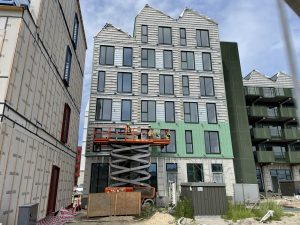
- Reclaimed and salvaged materials are used more frequently thanks to their lower carbon footprint, and a new industry has developed to provide these materials. We saw lots of repurposed metal siding, reclaimed slate and terracotta tiles, and re-use of bricks.
- There’s a stronger focus on retrofitting buildings rather than tearing them down, as the embodied carbon saved from reusing an existing structure can be reallocated to other aspects of the building.
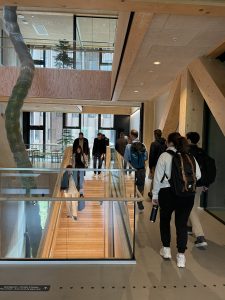
- Wood is prioritized as a building material, including mass timber, siding, and for interior finishes. We saw many wood floors and walls in the buildings we visited (even Copenhagen Airport had beautiful wood floors).

Affordable housing is “housing for all”
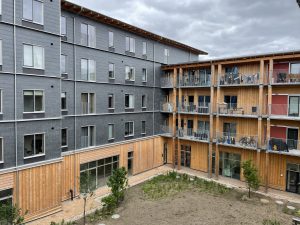
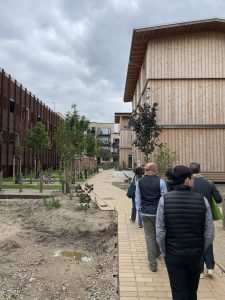
We visited new and renovated affordable housing properties during our time in Copenhagen. There, the approach to affordable housing is different—it’s treated as critical infrastructure, an acknowledgement that investments must be made to create and maintain existing housing and that these investments benefit everyone.
Everyone deserves a home that is affordable, low carbon, and ready for the future. The homes we visited were clean, quiet and comfortable—a place where everyone would want to live. The quiet from insulated building envelopes and high-performance windows is immediately noticeable and welcome. Creating a serene indoor environment is an underappreciated aspect of high-performance buildings, helping to reduce the impact of noise as a public health risk. The homes I visited reminded me of Toronto Community Housing’s Passive House retrofit of 50 Torbolton Drive, where the indoor environment is so quiet and comfortable that it has been identified as an ideal home for families with children who are sensitive to light or sound.
We’re beginning to see similar approaches locally. Build Canada Homes is focused on affordable housing at scale with support for modern methods of construction, and the Deep Retrofit Accelerator Initiative has helped to sustain and improve our existing housing stock through low carbon retrofits. What I saw in Copenhagen was the result of sustained support for climate policies and low carbon buildings—a future that we could build here in Canada, too.

What we can learn
As the GTHA makes plans and policies to rapidly reduce carbon emissions and mitigate climate change, we can take inspiration from some of Copenhagen’s successes; we already have the solutions and tools to help. Building for the future requires vision, long-term thinking, and commitment to stay the course. Underlying all of this is the recognition that decarbonization is an opportunity, not a cost.
What I saw in Copenhagen, and what is being replicated in more cities around the world, is proof that addressing climate and livability together is not only possible, but essential, and it can be done in just a few decades.



Thank you for this. It would have been helpful to learn more about Copenhagen’s district heating system which serves 98% of the buildings there.
Interesting.
My experience with accessing retrofit opportunities for our older condominium is one of continuous frustration.
In summary, older condominiums normally do not qualify for retrofit incentives. Where they do, they normally need the majority of owners to vote in support of a retrofit.
There is a need for building codes and urban polities to recognize the uniqueness of existing condominiums. Recognition should lead to accommodations.
Keep up the good work.