
Industrialized construction, prefabricated homes, and modern methods of construction have gained recent attention as governments and industry leaders search for scalable solutions to housing supply and climate resilience.
As policymakers and businesses find ways to improve productivity, reduce emissions, and address housing shortages, understanding the fundamentals of these construction systems is increasingly important. But what do these terms mean, and how do they fit together?
What is industrialized construction?
Modern methods of construction, industrialized construction, and prefabricated homes all fit together like nesting dolls.
- Modern methods of construction is “an umbrella term for innovative home building methods and technologies that can reduce cost, time, and labour intensity per housing unit delivered, if done at scale”
- Industrialized construction is the application of manufacturing principles to the construction process
- Prefabrication refers to building components that are engineered or assembled off-site
These processes are relatively new in the Canadian market, but that’s not the case globally. And while these practices feel new, they have been used for many thousands of years. The Sweet Track is an ancient, nearly 2km-long walkway built with prefabricated elements nearly 6,000 years ago. In the 1850s, Joseph Paxton designed the Crystal Palace, used for the first Great Exhibition in London’s Hyde Park. The nearly 1M sq. ft. structure was built in just 39 weeks, using modular construction techniques that enabled stacking pieces of the structure that were built simultaneously. More recently, we’ve seen industrialized construction progress with modular homes and the energiesprong movement.
What are the benefits?
Part of the reason industrialized construction has grown in recent years is its potential to help address existing problems in the traditional construction sector. It can help improve productivity in the construction industry, which has been in decline for decades. Construction timelines are long and costs are high, but prefabrication can help cut those timelines down and eventually reduce costs. While not a silver bullet for all concerns and issues, industrialized construction offers many benefits, thanks to most of the work happening in a controlled, factory environment:
- Product is higher quality and produces less waste
- Time on site is reduced, which can boost overall construction speed, reduce risk, and contribute to cost savings
- Work that appeals to a broader audience, expanding workforce opportunities, and improved safety for workers
Recognizing the potential to scale the industry and build a strong Canadian sector, the federal government launched Build Canada Homes (BCH). With a mission to scale up the supply of affordable housing across the country, BCH acts as a catalyst for modern methods of construction.
In this industry, Canada is lagging behind our peers with industrialized construction making up about 7% of the market. Europe has led the way, most notably in Sweden, where 84% of homes include prefabricated elements. This industry represents a huge growth opportunity for Canadian housing, our local workforce, and for entrepreneurs and Canadian companies.
In practice: retrofits + new construction
Industrialized construction elements can be used for both existing building retrofits and new construction. TAF is encouraging prefabricated panel suppliers to get into the retrofit space by pre-qualifying suppliers of prefabricated panels for both small and large buildings; we’re now up to seven panels on our rosters. New buildings using industrialized construction are being championed by the Canadian Industrialized Construction Coalition, an industry-led alliance of 100+ organizations supporting a factory-built construction supply chain. There are benefits to industrialized construction for both industries:
Existing Buildings:
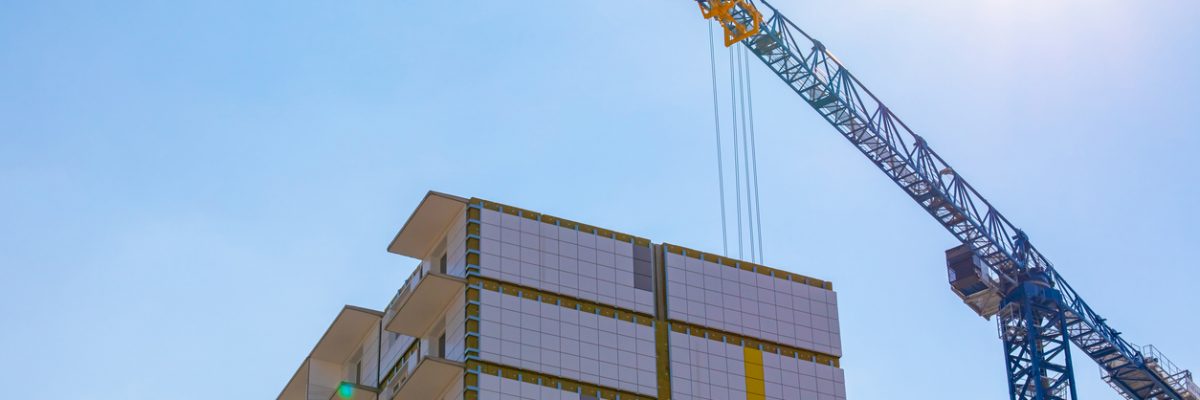
- Adding prefabricated overcladding panels to the building envelope provides better insulation, eliminates air leakage and improves resilience
- Inside the building, modular mechanical and electrical systems and prefabricated bulkheads improve efficiency and speed up project delivery
- Prefabrication minimizes disruption to residents and makes it easier to retrofit a building while keeping residents in place
New Construction:
- Potential for huge gains in speed and productivity for projects using industrialized construction make this a big opportunity for positive change
- Similar to retrofits, building envelope quality and performance can be greatly improved with prefabricated elements
- Industrialized construction for new buildings can be cost competitive to traditional methods, with the potential for substantial cost savings in the future as the industry matures
There are exciting projects happening across the GTHA that are utilizing industrialized construction, which should serve as case studies for future growth. TAF is wrapping up a Toronto Community Housing retrofit project using prefabricated panels, and supporting another landmark project underway on a 22-storey WoodGreen Community Housing building. In the new construction space, TAF investee Assembly Corp. has completed many projects using mass-timber prefabrication, and has secured a $5 million credit facility to support continued project development activities. Prequalified panel suppliers UnitiWall and Flynn both have inspiring new construction projects in the works using their panels. The future of housing in Canada needs to be green, resilient, and efficient—and industrialized construction is how we can get there.