
Canada’s 2026 federal budget recognizes a central truth about climate action which is that the government cannot finance the transition alone. But it can create the conditions that enable public and private capital to move.
Now the opportunity is to connect the 2026 budget programs and funding commitments to real projects, capable delivery partners and investors prepared to structure capital to achieve both financial and emissions reduction return on investment.
As shown in the figure below, key budget measures create enabling conditions for investors so they can convert the conditions into structured capital, deployable projects, evidence, and repeatable markets.
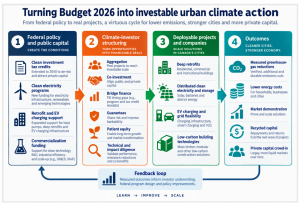 Budget 2026 commitments with the greatest investment mobilization potential
The focus of the budget commitments align closely with the investment challenges climate investors encounter: long project-development periods, uncertain incentive timing, fragmented project pipelines, high first-deployment costs and gaps between validated technologies and scaled commercial adoption.
- Longer-term clean investment tax credits. The budget proposes extending the refundable Clean Technology and Clean Electricity investment tax credits to the end of 2040. The Clean Technology credit remains at 30% and the Clean Electricity credit is 15%. Eligibility for the Clean Electricity credit would also expand to specified high-voltage intra-provincial transmission assets acquired on or after Budget Day.
- Electricity infrastructure and emerging technologies. Nearly $4 billion over ten years, beginning in 2027–28, is proposed for electricity infrastructure, renewable energy and priority projects, including new funding for the Smart Renewables and Electrification Pathways Program. A further $6 billion over six years, beginning in 2028–29, is earmarked for deployment of emerging electricity-generation technologies.
- EV charging and grid-smart solutions. The budget proposes $587 million over five years, beginning in 2027–28, to renew the Zero-Emission Vehicle Infrastructure Program and support more than 55,000 additional chargers. It also proposes $45 million over five years for EV-charging research and development.
- Retrofit market development. The previously announced National Heat Pump Rebate Program will receive $2 billion over eight years, starting in 2026–27, to support up to 820,000 households. The renewed Deep Retrofit Accelerator Initiative will receive nearly $110 million over three years, beginning in 2027–28.
- Industrial efficiency and clean-technology commercialization. The budget proposes $400 million over seven years, beginning in 2027–28, for the Strategic High-efficiency Industrial Facilities Transition. It also renews the IRAP Clean Technology Initiative and expands SR&ED eligibility to certain regulatory approval, certification and intellectual-property protection costs related to eligible projects.
- Early-stage and venture capital. Budget 2026 introduces the Canada Growth Incentive—$715 million in tax relief over four years beginning in 2027–28 through a capital-gains exemption of up to $15 million and an expanded small-business reinvestment rollover—and advances the BDC-delivered $750 million Early and Growth Stage Investment Strategy ($75 million for pre-seed and seed investment and $675 million for later- and growth-stage capital). It complements the previously announced $1 billion Growth VCCI, beginning in 2026–27. While these measures are not climate-dedicated, they expand the funds and co-investment capital available to climate-tech companies; notably, cleantech is expressly identified as a target of the pre-seed and seed stream.
- More consistent sustainable-finance definitions. Draft Made-in-Canada sustainable investment criteria for electricity, transportation and buildings are expected by the end of 2026. The budget also proposes a federal Sustainable Bond Framework and a February 2027 Sustainable Finance Conference.
What investors should do next
Federal measures can improve project economics, but they do not automatically produce investable transactions. Investors still need to originate projects, structure financing, allocate risk, assemble counterparties, and verify results. Action is needed by all investors to convert Budget 2026 support into positive outcomes.
- Build qualified pipelines before programs open. Investors should identify projects that could qualify for the renewed retrofit, EV-charging, electricity and industrial-efficiency programs. Early work should establish ownership, site control, technical readiness, permits, counterparties, capital needs and credible baseline emissions. This is especially important because the National Electricity Strategy anticipates calls for proposals and project advancement from renewed programs during its first six months of implementation.
- Turn incentives into financeable cash flows. Refundable tax credits and contribution programs can improve project economics, but timing remains important. Investors can develop bridge facilities, revolving credit, project-level construction finance and take-out structures that connect upfront costs with later tax-credit or program receipts, while underwriting eligibility and timing conservatively.
- Aggregate smaller urban projects. Individual retrofits, distributed-energy systems and EV-charging installations are frequently too small for institutional investors. Climate investors can create standardized eligibility rules, contracts, technical specifications and reporting, then aggregate multiple projects into portfolios suitable for senior lenders or infrastructure investors.
- Match each barrier with the right instrument. Not every opportunity needs equity. Investors should use guarantees, subordinated capital, performance-based financing, convertible instruments or warehouse facilities where those structures are better at addressing an identifiable barrier.
- Combine investment with market-building support. Capital alone may not resolve permitting, procurement, customer acquisition, workforce or regulatory barriers. Investors need to work with others to combine investment with policy, program delivery and market development initiatives to ensure pathways to scale. And investors should also support investees with customer introductions, local deployment partners, impact measurement, regulatory navigation and co-investor recruitment.
- Build evidence that attracts the next investor. Every catalytic investment should have a scaling plan and a measurement plan. Investors should document and share their results — including capital mobilized; tonnes of emissions reduced or credibly enabled; technology and project performance; total project cost and operating savings; and conditions required for replication – as well as lessons learned. That evidence and honesty is what allows early stage companies to scale, demonstration projects to become a conventional asset class, and build confidence for more capital providers.
How the federal government can help implementation succeed
While budget 2026 does a lot of heavy lifting the federal government can strengthen these measures by:
- Publishing eligibility, stacking, application and payment rules early;
- Coordinating rules across tax credits, contribution programs, the Canada Infrastructure Bank and other federal financing institutions;
- Creating formal co-investment pathways with experienced regional climate investors;
- Enabling smaller and aggregated projects—not only large infrastructure—to access programs;
- Using federal procurement and housing funding to create reliable demand for low-carbon solutions;
- Aligning affordable housing and infrastructure funding with measurable low-carbon performance; and
- Following up on announcements with reporting on actual capital deployed, private capital mobilized and emissions outcomes.
By working together to strategically leverage the 2026 Budget, we can create a virtuous circle that will scale climate solutions for the benefit of Canadians and investors. TAF looks forward to working alongside other stakeholders to see this come to fruition.

Leave a Reply