
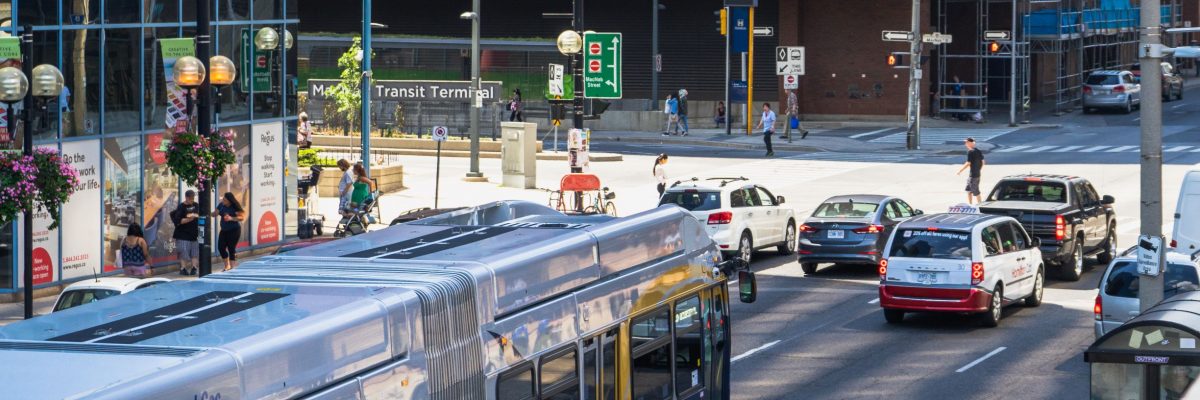
Low-density development, limited alternatives to driving, increasing e-commerce and ongoing highway expansions are all contributing to a steady rise in transportation emissions in the GTHA. Despite early progress on EV uptake, most of our transportation system still relies on fossil fuels. Given GTHA residents are some of the highest mileage drivers in North America, municipalities need to continue their efforts on electrification while also taking practical steps to reduce the total need for vehicle travel.
Put differently, rather than framing the issue as traffic congestion, it’s about focusing on expanding access to destinations while managing growth in overall vehicle-kilometres travelled (VKT) that will move the needle on decarbonization and traffic. Fortunately, municipalities have many tools to help do this.
5 recommendations to get cities moving
Public Transit: While major capital expansions draw headlines, municipalities should take a rider’s perspective and not lose sight of the basics: frequency, speed and reliability. The TTC’s strong bus ridership – among the highest in North America – shows how high-frequency, all-day service attracts riders. Suburban municipalities like Brampton have likewise earned international praise for ridership gains driven by service frequency.
With recent media focus on the new Finch West LRT’s lower-than-expected operating speeds, now is the time for GTHA municipalities to double down on making transit competitive through transit priority infrastructure and operational investments. In this municipal budget season, it’s always worth a reminder that if buses run faster, transit agencies can provide the same frequency with fewer vehicles, meaning lower operating costs without cutting service.
Short Trips: Does your municipality have a target for shifting short trips away from driving? Toronto has set a goal that 75% of trips under 5 km be made by non-auto modes like walking, cycling and transit. This sidesteps the common dismissal about trips in North American cities being too long to walk or cycle.
Getting people out of cars for short trips is low-hanging fruit: focus on neighbourhood-level mobility, including safer cycling routes, traffic-calmed walking connections, and shared micromobility systems (like bike and scooter share) that make short daily travel easier for people of all ages and abilities.
Parking: Outdated parking requirements inflate housing costs and reinforce car dependency. Modernized parking policies can give developers flexibility while ensuring parking exists where needed. Toronto’s elimination of minimum parking mandates in 2022 is a compelling example for other GTHA municipalities to follow.
TAF can help municipalities explore policy pathways – from updating zoning bylaws to piloting innovative parking management tools – that reflect modern travel patterns and reduce costs for all.
Shared Mobility: Sharing (our transportation) is caring (for the climate). Bikeshare, carshare, and carpooling all make more efficient use of public space, money, and infrastructure. And don’t forget the original shared mobility mode, public transit itself.
Municipalities should continue scaling shared mobility options and removing barriers to adoption in partnership with the private sector.
Goods movement: Rising ecommerce and “just-in-time” delivery mean freight emissions are becoming as critical as passenger emissions. As delivery trips replace personal errands, municipalities must ensure net emissions do not rise.
A renewed focus on freight emissions can consider urban consolidation centres to reduce duplicative trips and empty-vehicle travel; cargo e-bikes and micro-hubs for first/last-mile delivery in urban centres; modernized curb management; and of course the electrification of commercial fleets, supported by charging infrastructure.
Two Cross-cutting Suggestions:
- Data hygiene: Reliable, accessible data is key to tracking and accelerating decarbonization progress. Identify what transportation data your municipality needs, build strong systems for collecting and stewarding it, and publish it (e.g. open data) so partners can develop solutions and help surface insights.
- Dogfooding: A concept borrowed from the tech sector, “dogfooding” means using the product you’re building. Ride your transit system. Try a bikeshare or carshare. Take your colleagues on field trips. Municipal leaders who have an on-the-ground understanding of their transportation system will be best positioned to improve it.
Do you have an idea to reduce transportation emissions?
As a regional climate non-profit, TAF offers various support for your decarbonization journey. We provide policy and program design guidance for GTHA municipalities, grant funding, financing, and convening experts across sectors. Reach out to share your ideas and roadblocks – we’d love to work with you.
Contact Adam Rosenfield, TAF’s new Director of Clean Transportation at arosenfield@taf.ca.

Leave a Reply